The Harmonic Series Diverges Again and Again
In mathematics, the harmonic series is the space serial formed by summing all positive unit of measurement fractions:

The first terms of the series sum to approximately , where is the natural logarithm and is the Euler–Mascheroni constant. Because the logarithm has arbitrarily big values, the harmonic series does non have a finite limit: information technology is a divergent serial. Its divergence was proven in the 14th century by Nicole Oresme using a forerunner to the Cauchy condensation test for the convergence of space series. It tin also be proven to diverge by comparing the sum to an integral, co-ordinate to the integral test for convergence.


Applications of the harmonic series and its partial sums include Euler's proof that there are infinitely many prime number numbers, the analysis of the coupon collector's problem on how many random trials are needed to provide a consummate range of responses, the connected components of random graphs, the block-stacking problem on how far over the border of a tabular array a stack of blocks tin can be cantilevered, and the average case assay of the quicksort algorithm.
History [edit]

A moving ridge and its harmonics, with wavelengths

The name of the harmonic series derives from the concept of overtones or harmonics in music: the wavelengths of the overtones of a vibrating string are , , , etc., of the cord'due south fundamental wavelength.[1] [2] Every term of the harmonic series subsequently the showtime is the harmonic mean of the neighboring terms, so the terms form a harmonic progression; the phrases harmonic mean and harmonic progression likewise derive from music.[ii] Across music, harmonic sequences accept also had a certain popularity with architects. This was so especially in the Baroque menstruum, when architects used them to establish the proportions of flooring plans, of elevations, and to establish harmonic relationships between both interior and exterior architectural details of churches and palaces.[3]


The divergence of the harmonic serial was first proven in 1350 by Nicole Oresme.[ii] [4] Oresme'southward work, and the contemporaneous work of Richard Swineshead on a different series, marked the first appearance of infinite serial other than the geometric series in mathematics.[five] However, this achievement fell into obscurity.[six] Boosted proofs were published in the 17th century by Pietro Mengoli[two] [7] and by Jacob Bernoulli.[8] [9] [10] Bernoulli credited his brother Johann Bernoulli for finding the proof,[10] and it was later included in Johann Bernoulli's collected works.[eleven]
The partial sums of the harmonic serial were named harmonic numbers, and given their usual annotation , in 1968 by Donald Knuth.[12]

Definition and divergence [edit]
The harmonic serial is the infinite series

in which the terms are all of the positive unit fractions. It is a divergent series: as more terms of the series are included in partial sums of the series, the values of these fractional sums grow arbitrarily large, beyond whatsoever finite limit. Because information technology is a divergent series, it should be interpreted as a formal sum, an abstract mathematical expression combining the unit fractions, rather than as something that can be evaluated to a numeric value. There are many different proofs of the divergence of the harmonic series, surveyed in a 2006 paper by S. J. Kifowit and T. A. Stamps.[13] Two of the best-known[1] [xiii] are listed below.
Comparison examination [edit]
One mode to prove deviation is to compare the harmonic serial with another divergent series, where each denominator is replaced with the next-largest power of two:
![{\displaystyle {\begin{alignedat}{8}1&+{\frac {1}{2}}&&+{\frac {1}{3}}&&+{\frac {1}{4}}&&+{\frac {1}{5}}&&+{\frac {1}{6}}&&+{\frac {1}{7}}&&+{\frac {1}{8}}&&+{\frac {1}{9}}&&+\cdots \\[5pt]{}\geq 1&+{\frac {1}{2}}&&+{\frac {1}{\color {red}{\mathbf {4} }}}&&+{\frac {1}{4}}&&+{\frac {1}{\color {red}{\mathbf {8} }}}&&+{\frac {1}{\color {red}{\mathbf {8} }}}&&+{\frac {1}{\color {red}{\mathbf {8} }}}&&+{\frac {1}{8}}&&+{\frac {1}{\color {red}{\mathbf {16} }}}&&+\cdots \\[5pt]\end{alignedat}}}](https://wikimedia.org/api/rest_v1/media/math/render/svg/52165bdb2d88afeae9217446894857ce3f3a5d78)
Grouping equal terms shows that the second series diverges:
![{\displaystyle {\begin{aligned}&1+\left({\frac {1}{2}}\right)+\left({\frac {1}{4}}+{\frac {1}{4}}\right)+\left({\frac {1}{8}}+{\frac {1}{8}}+{\frac {1}{8}}+{\frac {1}{8}}\right)+\left({\frac {1}{16}}+\cdots +{\frac {1}{16}}\right)+\cdots \\[5pt]{}={}&1+{\frac {1}{2}}+{\frac {1}{2}}+{\frac {1}{2}}+{\frac {1}{2}}+\cdots .\end{aligned}}}](https://wikimedia.org/api/rest_v1/media/math/render/svg/38b4a5d095a99a621f29e320bb15524d97520c6b)
Considering each term of the harmonic series is greater than or equal to the corresponding term of the second series, information technology follows (by the comparison exam) that the harmonic series diverges likewise. The same argument proves more strongly that, for every positive integer ,

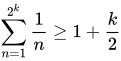
This is the original proof given past Nicole Oresme in around 1350.[13] The Cauchy condensation test is a generalization of this statement.[xiv]
Integral examination [edit]

Rectangles with surface area given by the harmonic serial, and the hyperbola through the upper left corners of these rectangles

It is possible to evidence that the harmonic series diverges past comparing its sum with an improper integral. Specifically, consider the system of rectangles shown in the figure to the right. Each rectangle is i unit wide and units high, and then if the harmonic series converged then the total area of the rectangles would be the sum of the harmonic series. The bend stays entirely below the upper purlieus of the rectangles, so the expanse under the bend (in the range of from ane to infinity that is covered by rectangles) would be less than the area of the marriage of the rectangles. However, the surface area under the curve is given by a divergent improper integral,


Because this integral does not converge, the sum cannot converge either.[13]
Replacing each rectangle by the next one in the sequence would produce a sequence of rectangles whose boundary lies below the curve rather than above it. This shows that the partial sums of the harmonic serial differ from the integral by an amount that is divisional above and below by the unit expanse of the showtime rectangle:

Generalizing this argument, any space sum of values of a monotone decreasing positive part of (like the harmonic serial) has fractional sums that are within a bounded distance of the values of the corresponding integrals. Therefore, the sum converges if and only if the integral over the same range of the aforementioned function converges. When this equivalence is used to check the convergence of a sum by replacing information technology with an easier integral, it is known every bit the integral test for convergence.[15]
Partial sums [edit]
| Partial sum of the harmonic series, | ||||
|---|---|---|---|---|
| expressed as a fraction | decimal | relative size | ||
| 1 | one | ~1 | i | |
| 2 | 3 | /ii | 1.5 | 1.5 |
| 3 | xi | /6 | ~1.83333 | 1.83333 |
| 4 | 25 | /12 | ~ii.08333 | 2.08333 |
| 5 | 137 | /60 | ~two.28333 | ii.28333 |
| six | 49 | /20 | 2.45 | 2.45 |
| vii | 363 | /140 | ~2.59286 | 2.59286 |
| eight | 761 | /280 | ~2.71786 | 2.71786 |
| 9 | 7129 | /2520 | ~ii.82897 | two.82897 |
| ten | 7381 | /2520 | ~two.92897 | 2.92897 |
| eleven | 83711 | /27720 | ~three.01988 | 3.01988 |
| 12 | 86021 | /27720 | ~iii.10321 | 3.10321 |
| xiii | 1145993 | /360360 | ~3.18013 | iii.18013 |
| 14 | 1171733 | /360360 | ~3.25156 | 3.25156 |
| 15 | 1195757 | /360360 | ~3.31823 | 3.31823 |
| xvi | 2436559 | /720720 | ~3.38073 | 3.38073 |
| 17 | 42142223 | /12252240 | ~3.43955 | 3.43955 |
| 18 | 14274301 | /4084080 | ~3.49511 | 3.49511 |
| 19 | 275295799 | /77597520 | ~3.54774 | 3.54774 |
| 20 | 55835135 | /15519504 | ~3.59774 | 3.59774 |
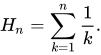
Adding the get-go terms of the harmonic serial produces a partial sum, chosen a harmonic number and denoted :[12]
Growth rate [edit]
These numbers grow very slowly, with logarithmic growth, as tin be seen from the integral exam.[15] More precisely,
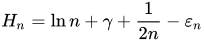
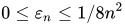
where is the Euler–Mascheroni abiding and which approaches 0 as goes to infinity.[sixteen]

Divisibility [edit]
No harmonic numbers are integers, except for .[17] [eighteen] One way to prove that is non an integer is to consider the highest ability of 2 in the range from 1 to . If is the to the lowest degree common multiple of the numbers from 1 to , and then tin can exist rewritten every bit a sum of fractions with equal denominators


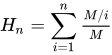
in which only one of the numerators, , is odd and the rest are even, and (when ) is itself even. Therefore, the result is a fraction with an odd numerator and an even denominator, which cannot exist an integer.[17] More strongly, any sequence of consecutive integers has a unique fellow member divisible by a greater power of two than all the other sequence members, from which it follows by the same statement that no 2 harmonic numbers differ by an integer.[eighteen]


Another proof that the harmonic numbers are not integers observes that the denominator of must be divisible by all prime number numbers greater than , and uses Bertrand's postulate to prove that this ready of primes is non-empty. The same argument implies more strongly that, except for , , and , no harmonic number can have a terminating decimal representation.[17] Information technology has been conjectured that every prime number divides the numerators of just a finite subset of the harmonic numbers, but this remains unproven.[19]


Interpolation [edit]
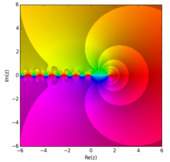
The digamma function is defined as the logarithmic derivative of the gamma role
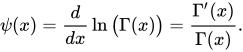
Merely as the gamma function provides a continuous interpolation of the factorials, the digamma function provides a continuous interpolation of the harmonic numbers, in the sense that .[twenty]

Applications [edit]
Many well-known mathematical problems have solutions involving the harmonic series and its partial sums.
Crossing a desert [edit]

Solution to the jeep trouble for , showing the amount of fuel in each depot and in the jeep at each stride

The jeep problem or desert-crossing problem is included in a 9th-century problem collection by Alcuin, Propositiones ad Acuendos Juvenes (formulated in terms of camels rather than jeeps), but with an wrong solution.[21] The problem asks how far into the desert a jeep tin travel and render, starting from a base with loads of fuel, past carrying some of the fuel into the desert and leaving it in depots. The optimal solution involves placing depots spaced at distances from the starting indicate and each other, where is the range of distance that the jeep can travel with a single load of fuel. On each trip out and back from the base, the jeep places one more than depot, refueling at the other depots along the style, and placing equally much fuel equally it can in the newly placed depot while still leaving enough for itself to return to the previous depots and the base. Therefore, the total distance reached on the th trip is



where is the thursday harmonic number. The departure of the harmonic series implies that crossings of any length are possible with enough fuel.[22]
For instance, for Alcuin's version of the problem, : a camel can deport thirty measures of grain and tin travel one leuca while eating a single measure out, where a leuca is a unit of distance roughly equal to two.3 kilometres (ane.four mi). The trouble has : in that location are 90 measures of grain, plenty to supply three trips. For the standard conception of the desert-crossing problem, it would be possible for the camel to travel leucas and return, by placing a grain storage depot five leucas from the base of operations on the get-go trip and 12.5 leucas from the base on the second trip. Notwithstanding, Alcuin instead asks a slightly different question, how much grain can be transported a altitude of 30 leucas without a final return trip, and either strands some camels in the desert or fails to account for the amount of grain consumed by a camel on its return trips.[21]


Stacking blocks [edit]

The block-stacking problem: blocks aligned according to the harmonic series can overhang the edge of a table by the harmonic numbers
In the cake-stacking problem, ane must place a pile of identical rectangular blocks, one per layer, and so that they hang every bit far as possible over the edge of a tabular array without falling. The top block can be placed with of its length extending beyond the next lower block. If information technology is placed in this mode, the adjacent cake downwardly needs to exist placed with at virtually of its length extending beyond the adjacent lower block, so that the center of mass of the pinnacle two cake is supported and they do not topple. The third block needs to be placed with at about of its length extending beyond the adjacent lower block, and then on. In this manner, it is possible to place the blocks in such a manner that they extend lengths beyond the table, where is the th harmonic number.[23] [24] The divergence of the harmonic serial implies that there is no limit on how far beyond the tabular array the cake stack can extend.[24] For stacks with one cake per layer, no better solution is possible, but significantly more overhang can be achieved using stacks with more than than i block per layer.[25]


Counting primes and divisors [edit]
In 1737, Leonhard Euler observed that, as a formal sum, the harmonic series is equal to an Euler product in which each term comes from a prime number number:

where denotes the prepare of prime number numbers. The left equality comes from applying the distributive law to the product and recognizing the resulting terms every bit the prime factorizations of the terms in the harmonic serial, and the right equality uses the standard formula for a geometric series. The product is divergent, just like the sum, only if it converged one could take logarithms and obtain


Here, each logarithm is replaced by its Taylor serial, and the constant on the right is the evaluation of the convergent series of terms with exponent greater than one. It follows from these manipulations that the sum of reciprocals of primes, on the correct hand of this equality, must diverge, for if it converged these steps could be reversed to show that the harmonic series also converges, which it does not. An immediate corollary is that there are infinitely many prime numbers, considering a finite sum cannot diverge.[26] Although Euler'south work is not considered adequately rigorous by the standards of modern mathematics, it can be made rigorous by taking more than care with limits and fault bounds.[27] Euler's conclusion that the partial sums of reciprocals of primes grow every bit a double logarithm of the number of terms has been confirmed by later mathematicians as one of Mertens' theorems,[28] and can be seen as a precursor to the prime number theorem.[27]

Another trouble in number theory closely related to the harmonic series concerns the average number of divisors of the numbers in a range from 1 to , formalized every bit the average club of the divisor part,
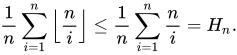
The operation of rounding each term in the harmonic series to the next smaller integer multiple of causes this boilerplate to differ from the harmonic numbers by a small abiding, and Peter Gustav Lejeune Dirichlet showed more than precisely that the boilerplate number of divisors is (expressed in large O notation). Bounding the final fault term more precisely remains an open problem, known as Dirichlet's divisor problem.[29]

Collecting coupons [edit]
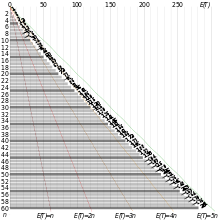
Graph of number of items versus the expected number of trials needed to collect all items
Several mutual games or recreations involve repeating a random selection from a set of items until all possible choices take been selected; these include the drove of trading cards[thirty] [31] and the completion of parkrun bingo, in which the goal is to obtain all 60 possible numbers of seconds in the times from a sequence of running events.[32] More serious applications of this problem include sampling all variations of a manufactured production for its quality command,[33] and the connectivity of random graphs.[34] In situations of this form, once in that location are items remaining to be nerveless out of a total of equally-likely items, the probability of collecting a new item in a unmarried random selection is and the expected number of random choices needed until a new particular is nerveless is . Summing over all values of from down to 1 shows that the full expected number of random choices needed to collect all items is , where is the th harmonic number.[35]


Analyzing algorithms [edit]
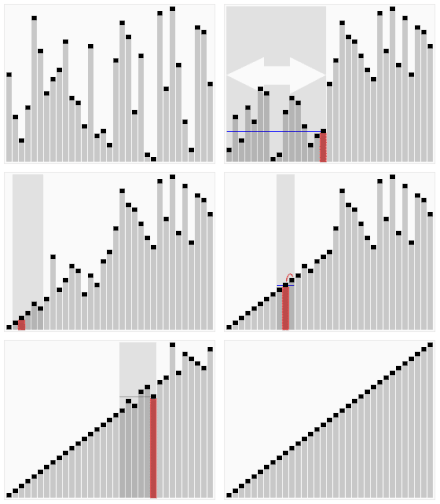
Animation of the average-case version of quicksort, with recursive subproblems indicated past shaded arrows and with pivots (red items and blue lines) chosen every bit the last detail in each subproblem
The quicksort algorithm for sorting a set of items tin can be analyzed using the harmonic numbers. The algorithm operates past choosing one item as a "pin", comparison it to all the others, and recursively sorting the 2 subsets of items whose comparison places them before the pivot and after the pivot. In either its average-instance complexity (with the assumption that all input permutations are equally likely) or in its expected time analysis of worst-example inputs with a random pick of pivot, all of the items are as likely to be called as the pivot. For such cases, one can compute the probability that two items are ever compared with each other, throughout the recursion, as a function of the number of other items that split them in the final sorted society. If items and are separated by other items, and so the algorithm will make a comparison between and only when, as the recursion progresses, it picks or every bit a pivot earlier picking any of the other items betwixt them. Because each of these items is every bit likely to be chosen first, this happens with probability . The total expected number of comparisons, which controls the total running time of the algorithm, can so be calculated by summing these probabilities over all pairs, giving[36]



The divergence of the harmonic series corresponds in this application to the fact that, in the comparison model of sorting used for quicksort, it is not possible to sort in linear fourth dimension.[37]
[edit]
Alternate harmonic series [edit]

The first 14 partial sums of the alternating harmonic series (black line segments) shown converging to the natural logarithm of 2 (red line).
The series

is known as the alternating harmonic series. It is conditionally convergent by the alternating series examination, only not absolutely convergent. Its sum is the natural logarithm of 2.[38]
Using alternating signs with but odd unit fractions produces a related series, the Leibniz formula for π [39]

Riemann zeta role [edit]
The Riemann zeta function is defined for real past the convergent series


which for would exist the harmonic serial. It can be extended past analytic continuation to a holomorphic function on all complex numbers except , where the extended function has a elementary pole. Other important values of the zeta function include , the solution to the Basel problem, Apéry's constant , proved by Roger Apéry to be an irrational number, and the "critical line" of circuitous numbers with existent office , conjectured past the Riemann hypothesis to exist the only values other than negative integers where the function can exist zero.[forty]


Random harmonic series [edit]
The random harmonic serial is

where the values are independent and identically distributed random variables that accept the two values and with equal probability . It converges with probability ane, equally can be seen past using the Kolmogorov three-series theorem or of the closely related Kolmogorov maximal inequality. The sum of the serial is a random variable whose probability density function is close to for values between and , and decreases to near-zero for values greater than or less than . Intermediate between these ranges, at the values , the probability density is for a nonzero but very small value .[41] [42]


Depleted harmonic serial [edit]
The depleted harmonic series where all of the terms in which the digit 9 appears anywhere in the denominator are removed tin can be shown to converge to the value 22.9206766192 64150 34816 ... .[43] In fact, when all the terms containing any particular string of digits (in any base) are removed, the series converges.[44]
References [edit]
- ^ a b Rice, Adrian (2011). "The harmonic series: A primer". In Jardine, Dick; Shell-Gellasch, Amy (eds.). Mathematical Time Capsules: Historical Modules for the Mathematics Classroom. MAA Notes. Vol. 77. Washington, DC: Mathematical Association of America. pp. 269–276. ISBN978-0-88385-984-ane.
- ^ a b c d Kullman, David E. (May 2001). "What's harmonic about the harmonic series?". The College Mathematics Journal. 32 (3): 201–203. doi:10.2307/2687471. JSTOR 2687471.
- ^ Hersey, George Fifty. (2001). Architecture and Geometry in the Age of the Baroque. University of Chicago Press. pp. 11–12, 37–51. ISBN978-0-226-32783-nine.
- ^ Oresme, Nicole (c. 1360). Quaestiones super Geometriam Euclidis [Questions apropos Euclid'due south Geometry] (in Latin).
- ^ Stillwell, John (2010). Mathematics and its History. Undergraduate Texts in Mathematics (third ed.). New York: Springer. p. 182. doi:10.1007/978-1-4419-6053-5. ISBN978-1-4419-6052-8. MR 2667826.
- ^ Derbyshire, John (2003). Prime Obsession: Bernhard Riemann and the Greatest Unsolved Problem in Mathematics. Washington, DC: Joseph Henry Press. p. ten. ISBN0-309-08549-7. MR 1968857.
- ^ Mengoli, Pietro (1650). "Praefatio [Preface]". Novae quadraturae arithmeticae, seu De additione fractionum [New arithmetic quadrature (i.e., integration), or On the addition of fractions] (in Latin). Bologna: Giacomo Monti. Mengoli'due south proof is by contradiction: Let denote the sum of the series. Group the terms of the series in triplets: . Since for , , and then , which is impossible for whatsoever finite . Therefore, the serial diverges.
- ^ Bernoulli, Jacob (1689). Propositiones arithmeticae de seriebus infinitis earumque summa finita [Arithmetical propositions about infinite series and their finite sums]. Basel: J. Conrad.
- ^ Bernoulli, Jacob (1713). Ars conjectandi, opus posthumum. Accedit Tractatus de seriebus infinitis [Theory of inference, posthumous work. With the Treatise on infinite series…]. Basel: Thurneysen. pp. 250–251.
From p. 250, prop. sixteen:- "Sixteen. Summa serei infinita harmonicè progressionalium, &c. est infinita. Id primus deprehendit Frater:…"
- [sixteen. The sum of an infinite series of harmonic progression, , is infinite. My blood brother first discovered this…]
- ^ a b Dunham, William (January 1987). "The Bernoullis and the harmonic series". The College Mathematics Periodical. 18 (1): 18–23. doi:10.1080/07468342.1987.11973001. JSTOR 2686312.
- ^ Bernoulli, Johann (1742). "Corollary III of De seriebus varia". Opera Omnia. Lausanne & Basel: Marc-Michel Bousquet & Co. vol. 4, p. 8. Johann Bernoulli's proof is also past contradiction. It uses a scope sum to represent each term as Changing the order of summation in the respective double series gives, in modern notation.
- ^ a b Knuth, Donald E. (1968). "1.ii.7 Harmonic numbers". The Fine art of Computer Programming, Volume I: Fundamental Algorithms (1st ed.). Addison-Wesley. pp. 73–78. Knuth writes, of the partial sums of the harmonic series "This sum does non occur very oft in classical mathematics, and there is no standard notation for it; but in the analysis of algorithms information technology pops upwardly nearly every time we plough around, and nosotros will consistently use the symbol ... The letter stands for "harmonic", and we call a "harmonic number" considering [the infinite serial] is customarily called the harmonic series."
- ^ a b c d Kifowit, Steven J.; Stamps, Terra A. (Leap 2006). "The harmonic series diverges again and once more" (PDF). AMATYC Review. American Mathematical Clan of Ii-Twelvemonth Colleges. 27 (2): 31–43. Come across too unpublished addendum, "More than proofs of divergence of the harmonic serial" by Kifowit.
- ^ Roy, Ranjan (December 2007). "Review of A Radical Approach to Real Assay past David Grand. Bressoud". SIAM Review. 49 (4): 717–719. JSTOR 20454048.
Ane might point out that Cauchy's condensation test is but the extension of Oresme's statement for the divergence of the harmonic series
- ^ a b Bressoud, David M. (2007). A Radical Arroyo to Real Analysis. Classroom Resource Materials Serial (2nd ed.). Washington, DC: Mathematical Association of America. pp. 137–138. ISBN978-0-88385-747-2. MR 2284828.
- ^ Boas, R. P. Jr.; Wrench, J. Westward. Jr. (1971). "Partial sums of the harmonic series". The American Mathematical Monthly. 78: 864–870. doi:10.1080/00029890.1971.11992881. JSTOR 2316476. MR 0289994.
- ^ a b c Havil, Julian (2003). "Chapter 2: The harmonic serial". Gamma: Exploring Euler'due south Abiding. Princeton University Printing. pp. 21–25. ISBN978-0-691-14133-6.
- ^ a b Osler, Thomas J. (November 2012). "96.53 Partial sums of series that cannot be an integer". The Mathematical Gazette. 96 (537): 515–519. doi:ten.1017/S0025557200005167. JSTOR 24496876. Come across in particular Theorem 1, p. 516.
- ^ Sanna, Carlo (2016). "On the -adic valuation of harmonic numbers". Journal of Number Theory. 166: 41–46. doi:10.1016/j.jnt.2016.02.020. MR 3486261.
- ^ Ross, Bertram (1978). "The psi function". Mathematics Mag. 51 (3): 176–179. doi:10.1080/0025570X.1978.11976704. JSTOR 2689999. MR 1572267.
- ^ a b Hadley, John; Singmaster, David (March 1992). "Problems to sharpen the young: An annotated translation of Propositiones advertizement acuendos juvenes". The Mathematical Gazette. 76 (475): 102–126. doi:x.2307/3620384. JSTOR 3620384. See problem 52: De homine patrefamilias – A lord of the estate, pp. 124–125.
- ^ Gale, David (May 1970). "The jeep once more or jeeper by the dozen". The American Mathematical Monthly. 77 (5): 493–501. doi:10.1080/00029890.1970.11992525. JSTOR 2317382.
- ^ Graham, Ronald; Knuth, Donald Eastward.; Patashnik, Oren (1989). "six.3 Harmonic numbers". Concrete Mathematics (2e ed.). Addison-Wesley. pp. 272–278. ISBN978-0-201-55802-nine.
- ^ a b Abrupt, R. T. (1954). "Problem 52: Overhanging dominoes" (PDF). Pi Mu Epsilon Periodical. 1 (ten): 411–412.
- ^ Paterson, Mike; Peres, Yuval; Thorup, Mikkel; Winkler, Peter; Zwick, Uri (2009). "Maximum overhang". The American Mathematical Monthly. 116 (nine): 763–787. doi:10.4169/000298909X474855. MR 2572086.
- ^ Euler, Leonhard (1737). "Variae observationes circa series infinitas" [Various observations apropos infinite series]. Commentarii Academiae Scientiarum Petropolitanae (in Latin). nine: 160–188.
- ^ a b Rubinstein-Salzedo, Simon (2017). "Could Euler take conjectured the prime number theorem?". Mathematics Magazine. 90 (5): 355–359. doi:10.4169/math.mag.90.5.355. JSTOR x.4169/math.mag.xc.v.355. MR 3738242.
- ^ Pollack, Paul (2015). "Euler and the partial sums of the prime harmonic series". Elemente der Mathematik. lxx (1): thirteen–twenty. doi:10.4171/EM/268. MR 3300350.
- ^ Tsang, Kai-Man (2010). "Recent progress on the Dirichlet divisor problem and the mean square of the Riemann zeta-function". Science China. 53 (9): 2561–2572. doi:10.1007/s11425-010-4068-six. MR 2718848.
- ^ Maunsell, F. G. (Oct 1938). "A problem in cartophily". The Mathematical Gazette. 22 (251): 328–331. doi:10.2307/3607889. JSTOR 3607889.
- ^ Gerke, Oke (April 2013). "How much is it going to cost me to complete a collection of football trading cards?". Education Statistics. 35 (2): 89–93. doi:x.1111/test.12005.
- ^ Parker, Matt (February 12, 2022). "The coupon collector's problem (with Geoff Marshall)". Stand-up maths. YouTube.
- ^ Luko, Stephen N. (March 2009). "The "coupon collector'due south problem" and quality control". Quality Engineering. 21 (2): 168–181. doi:10.1080/08982110802642555.
- ^ Frieze, Alan; Karoński, Michał (2016). "iv.ane Connectivity". Introduction to Random Graphs. Cambridge Academy Printing, Cambridge. pp. 64–68. doi:ten.1017/CBO9781316339831. ISBN978-1-107-11850-8. MR 3675279.
- ^ Isaac, Richard (1995). "8.4 The coupon collector's trouble solved". The Pleasures of Probability. Undergraduate Texts in Mathematics. New York: Springer-Verlag. pp. fourscore–82. doi:10.1007/978-1-4612-0819-8. ISBN0-387-94415-X. MR 1329545.
- ^ Cormen, Thomas H.; Leiserson, Charles Due east.; Rivest, Ronald L.; Stein, Clifford (2009) [1990]. "Chapter vii: Quicksort". Introduction to Algorithms (third ed.). MIT Press and McGraw-Hill. pp. 170–190. ISBN0-262-03384-4.
- ^ Cormen et al. (2009), Section viii.1, "Lower bounds for sorting", pp. 191–193. sfnp mistake: no target: CITEREFCormenLeisersonRivestStein2009 (assist)
- ^ Freniche, Francisco J. (2010). "On Riemann's rearrangement theorem for the alternating harmonic serial". The American Mathematical Monthly. 117 (v): 442–448. doi:10.4169/000298910X485969. JSTOR 10.4169/000298910x485969. MR 2663251.
- ^ Soddy, F. (1943). "The iii infinite harmonic series and their sums (with topical reference to the Newton and Leibniz serial for )". Proceedings of the Regal Society. 182: 113–129. doi:10.1098/rspa.1943.0026. MR 0009207.
- ^ Bombieri, E. (2010). "The classical theory of zeta and -functions". Milan Journal of Mathematics. 78 (1): xi–59. doi:10.1007/s00032-010-0121-viii. MR 2684771.
- ^ Schmuland, Byron (May 2003). "Random harmonic series" (PDF). The American Mathematical Monthly. 110 (5): 407–416. doi:10.2307/3647827. JSTOR 3647827.
- ^ Bettin, Sandro; Molteni, Giuseppe; Sanna, Carlo (2018). "Small values of signed harmonic sums". Comptes Rendus Mathématique. 356 (eleven–12): 1062–1074. arXiv:1806.05402. doi:10.1016/j.crma.2018.11.007. hdl:2434/634047. MR 3907571.
- ^ Baillie, Robert (May 1979). "Sums of reciprocals of integers missing a given digit". The American Mathematical Monthly. 86 (5): 372–374. doi:10.1080/00029890.1979.11994810. JSTOR 2321096.
- ^ Schmelzer, Thomas; Baillie, Robert (June 2008). "Summing a curious, slowly convergent serial". The American Mathematical Monthly. 115 (6): 545–540. JSTOR 27642532.












External links [edit]
- Weisstein, Eric W. "Harmonic Serial". MathWorld.
Source: https://en.wikipedia.org/wiki/Harmonic_series_(mathematics)
0 Response to "The Harmonic Series Diverges Again and Again"
Post a Comment