Most Famous Mesopotamian Art Indian Chinese and Japanese Art
When students or museumgoers are asked to name examples of art from ancient times, they oft listing examples from Egypt, Greece, or Rome. Depending on their country of origin, they might likewise include works from China and Republic of india. Historians generally consider the ancient menstruum of Egypt to exist from most 3150 BC to 332 BC, that of Greece from 1200 BC to 600 Advert, and that of Rome from about 800 BC to 600 AD. Historians consider the ancient period of Mainland china to run from the founding of the Xia dynasty in the early 21st century BC to the early on 7th century Advertizement with the establishment of the Tang dynasty. The Indus River civilisation and the Harappan civilization, which encompassed southeastern Pakistan and northwestern Bharat, were both well established by 2700 BC.
Each of these civilizations left behind beautiful examples of their art. The Egyptians left the pyramids and other fantastic memorials to their dead. The Greeks and Romans left endless temples and statues throughout the Mediterranean world. The Chinese left manuscripts, terra cotta statues and much more. The Indus River civilisation left elaborate bronze and a archaic written language. The oldest of these examples, as we can encounter, are those from ancient Egypt – which in some cases are approximately 5,000 years old. However, all of the higher up examples are quite youngwhen contrasted with the civilizations that developed in Mesopotamia, the lands of present-twenty-four hours Iraq and Kuwait. The first recognizable Mesopotamian civilization, the Sumer, began approximately 6,000 years agone in 4000 BC. Other Mesopotamian cultures include the Akkadians, the Old and New Babylonian cultures, and the Hittites.
The discussion "Mesopotamia" means "the land between two rivers" in Greek. In this case, the rivers are the Tigris and the Euphrates that run roughly parallel to each other from their sources in the mountains of eastern Turkey and and then southeast to the Persian Gulf. The Euphrates, the southernmost of the two, too runs through the northwestern part of Syria. Both are big, navigable rivers along most of their length and, especially in aboriginal times, the silt left in the area from flooding left the soil rich in the nutrients needed to sustain agriculture.
For thousands of years earlier the rise of the Sumer, people's main concern was survival. One result of man'south ho-hum shift from existing in traveling bands of hunter-gatherers to settled cultures that relied on agriculture and the domestication of animals for food was that for the first time not all members of society were required to grow or provide nutrient. People became regime officials, craftsmen, and artists, among other things.
Equally these civilizations developed, artists (oftentimes at the direction of the rulers and priests higher up them) began to portray the earth around them, their ideas about the afterlife and the realms of the gods, and glorify their leaders.
Hither we will list ix of the greatest works of art of the ancient cultures of Mesopotamia:
9. The White Temple and Great Ziggurat of Uruk
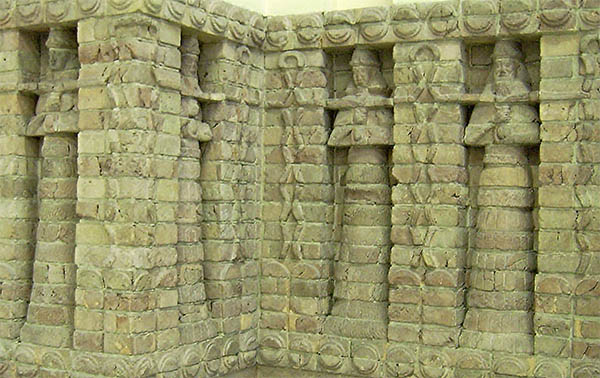
Located on the Euphrates in what is now southeastern Iraq, Uruk is dwelling house to possibly the Sumerians' most important temple to the gods, the White Temple and Cracking Ziggurat. Uruk was a major city for early on Sumerian culture and home to the slap-up Sumerian hero Gilgamesh who features in the famous epic poem of that name, 1 of the earliest examples of narrative that survives today.
The remains of one of the nearly important temples of ancient Sumer now bakes in the Iraqi sun. For tourists, historians and archeologists, a great deal of imagination is required to picture the ziggurat as information technology actually was 5,000 years ago. Time, sun, wind, and erosion has taken its toll on the structure, just from writings and by archeological extrapolation, we can build upwardly a motion picture of what the construction looked like at the meridian of Sumer'south ability.
Like many other cultures, the Sumerians believed the gods lived in the heaven, so they constructed many of their temples on the highest signal possible and fabricated them as tall every bit the building applied science of the time allowed. A ziggurat is a stepped pyramid. In this case, it is a broad one with a large, apartment expanse at its apex where a massive temple was erected. Here, priests would offering prayers and sacrifices to the gods, and receive messages from the deities themselves.
The White Temple was 40 feet high (12 meters), congenital of brick (usable rock was rare in the region), and comprised an area of 56 x 72 square anxiety (17 x 22 square meters). Historians estimate that it took 1,500 laborers five years to construct the temple. Within the temple, archeologists have plant the burnt skeletal remains of a leopard and a lion, a number of stone tablets reflecting the accounting of the temple, and a fire pit where it is believed that burnt offerings were given to the gods. Additionally, they believe they take establish evidence of a fountain or h2o system inside the temple, which indicates a level of technological understanding beyond that which we would normally associate with very ancient times.
8. Statues of Tell Asmar
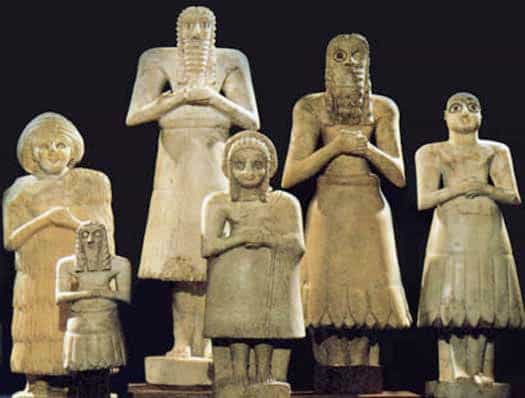
In the 2009 movie The Fourth Kind, a psychologist works with people who accept allegedly been abducted and their bodies inhabited by aliens and subjected to all sorts of terrors. Soon, she is visited by these aliens herself and begins to record their visits. She besides hires a team of UFO experts to aid her get to the bottom of the mystery. 1 of these experts is a historian who has traced alien abduction and visitation stories throughout history. Information technology is his belief that beings from some other planet accept been visiting the earth for thousands of years. To "testify" his theory, he points out various statues and friezes of the Sumerian and other Mesopotamian cultures such equally the Elamites of the powerful city of Eshnunna.
Two of the figures he believes might exist depictions of aliens are the votive statues of Tell Asmar from around 2700 BC. Their large eyes are like to those that nosotros associate with visiting aliens. Other plausible-sounding similarities are concocted to atomic number 82 us to believe that perhaps aliens accept been visiting and ruling over us for centuries.
The true story of the figures is this: Only as worshipers light a candle and say a prayer to remember their loved ones in some Christian churches today, these statues represented the deceased. In many cases, names accept been found on the bottom of the figures, along with a written prayer. The twelve figures of Tell Asmar (ten men and two women) were institute close together in a temple area. It is believed that the wide, alien-like eyes of the statuettes were to brand sure that they were able to encounter any messages or responses given past the gods, no matter how small or subtle.
Eight of the statues are made from gypsum, 2 from limestone and i from alabaster. The dark, oversized eyes are made from bitumen (coal) and one effigy's pupils are fabricated from lapis lazuli. The beards of the men and other nighttime markings and shadings on the figures were also inlays of bitumen coal.
vii. The Standard of Ur
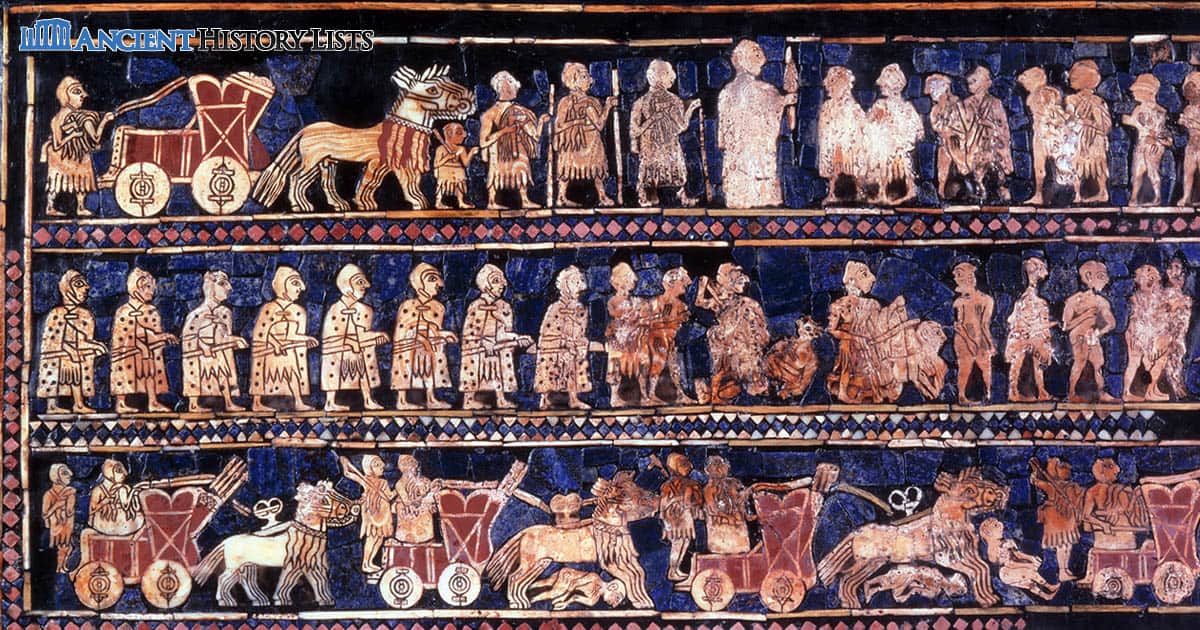
Establish in the 1920s past British archeologists (Iraq was and then governed by Uk), the Standard of Ur is a beautiful piece of art that is four,600 years old. The standard is actually a mosaic, non a piece of cloth as the proper noun would suggest. Though much of the piece has been lost to time and thieves, a significant portion of it exists today in the British Museum in London.
The Standard is fabricated from red limestone and lapis lazuli (which forms the blue groundwork). These materials were not cheap, and the mosaic was prepared for the tomb of a king, Ur-Pabilsag, who died effectually 2550 BC. The mosaic is a partial story of his life and reign and gives us an insight into Mesopotamian culture.
Originally believed to be covering a hollow, four-sided box, the mosaic is actually quite small – 8.v inches wide and 19.5 inches long – but provides great particular most aspects of life in aboriginal Mesopotamia. The two surviving fragments have been labeled "State of war" and "Peace." The first shows the king, a 2-dimensional, towering figure, viewing a procession of naked prisoners (some of them wounded) being marched past his chariot. Mesopotamian soldiers are shown in their helmets with weapons at the ready.
We too see a number of horse-fatigued chariots. From these images, nosotros know what these soldiers wore, and with what (and how) they likely fought. The horses lack bits in their mouths as this was an invention that came a one thousand years afterwards. Instead, they were directed by other means such as ropes along or inside the nose. Enemies are being paraded before them and are being trampled underneath the chariots.
The other fragment, "Peace," again shows an outsized king at the head of a banquet, which includes a vocaliser, a lyre histrion, fish and other animals, also every bit various fruits and vegetables.
6. The Victory Stele of Naram-Sin
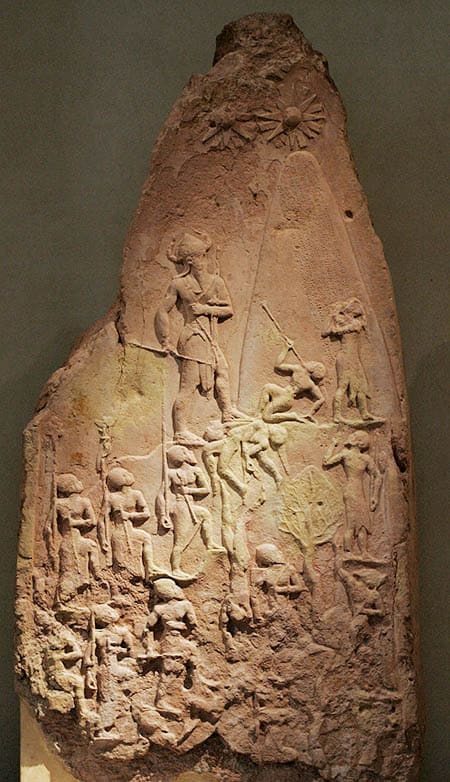
Another of the ancient Mesopotamian cultures was that of Akkadia, which ruled much of Mesopotamia from approximately 2334 BC to 2154 BC. The Akkadians controlled most of the length of the navigable parts of the Tigris and Euphrates rivers, which gave them great power. Similar other civilizations throughout the centuries, the Akkadians erected monuments in honor of their great kings and warriors and, in the process, elevated them to a sort of god-like status.
The Victory Stele of Naram-Sin commemorates the triumph of the Akkadian king Naram-Sin over the Lullubi who lived in the Zagros Mountains of present-24-hour interval Iran. We can tell a lot about King Naram-Sin only from looking at this stele. Most of the armed forces/triumphant friezes of Mesopotamia and later are horizontal, with the male monarch marching or riding at the front or rear of a procession of soldiers, priests, and/or prisoners. In this case, the stele depicts the victory of Naram-Sin in an upward, semi-triangular way, with the king at its apex and much larger than the figures below him, which decrease in size as y'all go closer to the bottom of the stone.
The Akkadians believed that merely deceased kings became gods, but here Naram-Sin is wearing the helmet of a god and his confront is depicted as that of a panthera leo, something which other works tell the states is reserved only for the gods. Like many conquerors that came subsequently him, Naram-Sin must take had some ego.
five. Ashurbanipal and His Queen in the Garden
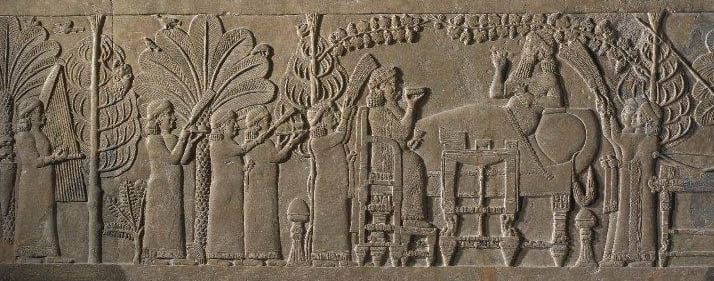
Ashurbanipal was male monarch of the Assyrian Empire from 668 BC to 627 BC, a relatively recent king compared to those we have already mentioned. Really, if you lot remember but in terms of time, the reign of Ashurbanipal is closer on a timeline to united states in today than to the people of Ur 3,200 years ago.
In this frieze of the king and his wife, we encounter life in the royal court in a different setting. Hither the rex and queen are relaxing and enjoying themselves. This shows that the queen must have either been quite important or the king must accept loved her a great deal – or both. Queens did non appear in Assyrian art with much frequency, unlike the Egyptian art nosotros are more than familiar with.
Speaking of Egypt, we can see weapons in the background of the frieze which bespeak perhaps a contempo campaign against the Egyptians. We see vino goblets, fruit, slaves, and a severed head in the groundwork. We tin can likewise run across incense burners and slaves fanning away the desert flies. Some historians have noted that in this piece of work, the faces of the king and queen (who are rendered in an well-nigh 3-dimensional manner) take been defaced, while the faces of the slaves and servants take not. This leads historians to believe that Ashurbanipal and his queen must have been hated figures.
4. The Bull Lyre
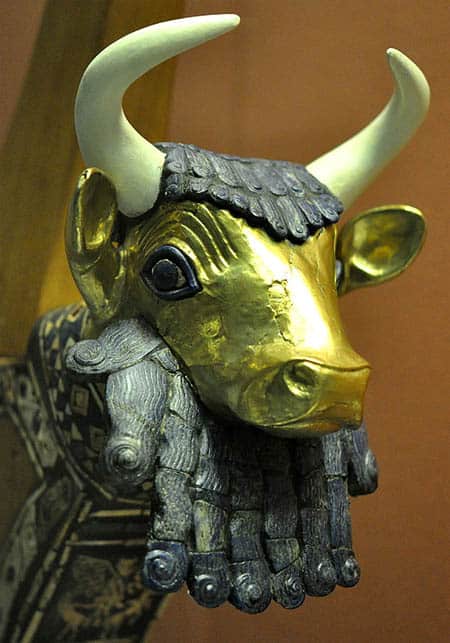
One of the most beautiful pieces of art recovered from Mesopotamia is the Bull Lyre. Found in the tomb of Queen Puabi (c. 2680 BC), the lyre was meant to help the queen fend off loneliness in, and on to the journey to, the afterlife. The lyre is 112cm high, 73cm long, and the body is 7cm broad. The trunk is a sort of rectangular box continuing on one of its lower sides, out of which the body of the lyre grows. The front of the lyre is adorned with the face up of a blue bull (created by a lapis-lazuli inlay), and down the forepart of the bull'due south chest are depictions from scenes at court. Whether the lyre was actually playable when created is unknown.
3. The Stele of Hammurabi
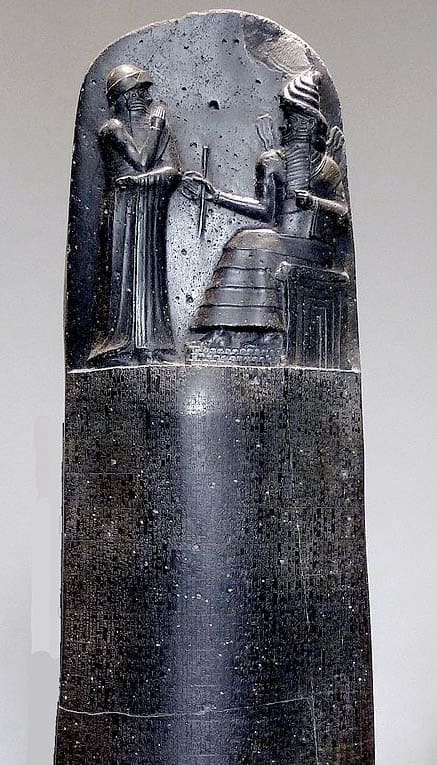
Hammurabi is one of the most famous of the ancient kings. He ruled Babylon from 1810 BC to 1750 BC and is responsible for one of the only (and commencement) surviving written codes of law. Supposedly given to him past the god Shamash, the Hammurabi Lawmaking details laws surrounding many aspects of life in ancient Babylon, and the laws were carved into a rock stele and so that they could be seen past everyone. By carving his laws on this stele, Hammurabi was also making a statement that would exist remembered well into the future. Hammurabi was declaring that the police force should non exist arbitrary and fabricated on a whim. Although a piece of work of government, the stele has since taken on an aspect of fine art, largely due to its use of cuneiform.
Cuneiform, meaning "wedge shaped" in Latin, was ane of the earliest writing systems in history. It began around 6000 years agone as a series of pictograms and developed into a wedge-shaped or triangular alphabet for exactitude and understanding. Over fourth dimension, artifacts from Babylonia and Mesopotamia engraved with cuneiform have been considered works of art. From the late 19thursday century through today, neo-primitive artists will include cuneiform writing in their work to add atmosphere or meaning.
ii. Lamassu
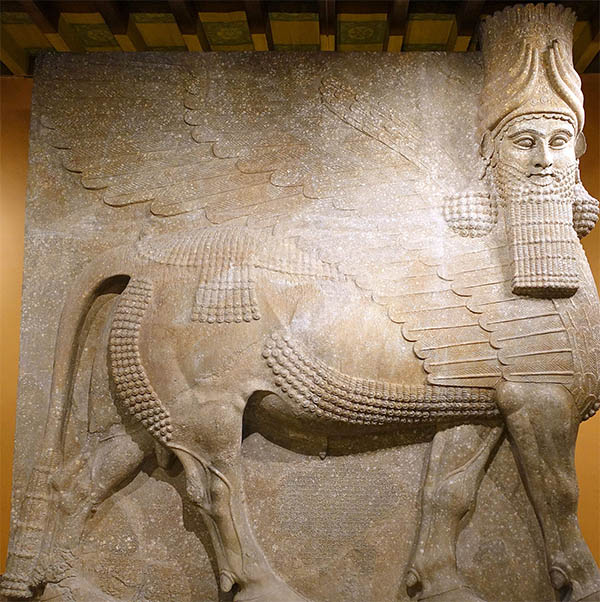
In Mesopotamian culture, the lamassu were protective gods with the heads of purple humans, the bodies of bulls or lions, and the wings of birds. Much like the guardian lions, lion dogs, and dragons of Prc, the lamassu guarded temples and palaces to ensure no damage would come up to the king and priests and to make sure prayers were protected.
The faces of the lamassu (and in that location are a number of them nevertheless in beingness) are what nearly people associate with the appearance of Mesopotamian rulers or priests. They wear a large miter-type hat with a flat top (something similar the headgear of Eastern Orthodox officials) and a long square-ended beard spun into curls. In much the aforementioned way as we retrieve of Male monarch Tut or the Sphinx as beingness typical of ancient Arab republic of egypt, people oft acquaintance the face of the lamassu with the rulers of Mesopotamia.
Most of the surviving lamassu figures are big and imposing – they were supposed to exist, as they were the guardians of the temples and the gateways to the gods. The most famous pair of lamassu, at Sargon 2'due south temple at Khorsabad in northern Republic of iraq, stand up much higher and wider than the people. Another interesting fact virtually these balderdash- or panthera leo-bodied guardians is that they often have five legs.
1. The Ishtar Gate
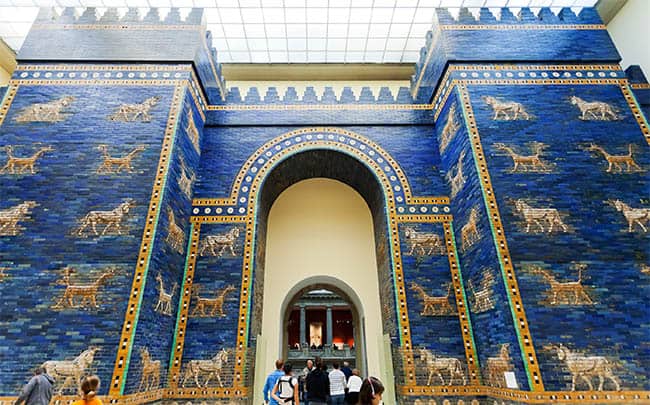
The Ishtar Gate, reconstructed and displayed in the Pergamon Museum in Berlin since 1930, was created during the fourth dimension of the longest-reigning Babylonian monarch, Nebuchadnezzar Two (634 BC–532 BC). Found on the northward side of the ruins of Babylon in disrepair, the gate was reconstructed using original bricks and repainted. Today, the Ishtar Gate is considered by many to be the finest case of Mesopotamian art.
The gate itself is large: it is 14 feet high and 100 feet wide. Its crenellated towers testify an architectural mastery, and its gold and yellowish mosaics indicated that ane was passing through into a rich and powerful city. From remnants of dyes and paints, restorers believe that the Ishtar Gate was colored, or topped, with lapis lazuli. The lapis-colored paint was expensive and indicates the importance of the structure.
It is believed that the Ishtar Gate was simply the last construction on a long route leading into the north side of the city. Historians and archaeologists believe that the road leading to the gate was lined with miniature castle towers, all crenelated like the acme of the Ishtar Gate – whether this was purely artful, to protected archers, or both is uncertain.
Source: https://www.ancienthistorylists.com/mesopotamia-history/outstanding-mesopotamian-art/
0 Response to "Most Famous Mesopotamian Art Indian Chinese and Japanese Art"
Post a Comment